SECRETARY-GENERAL, IN MESSAGE FOR INTERNATIONAL YOUTH DAY, WARNS AGAINST CREATING
‘LOST GENERATION OF SQUANDERED TALENT AND DREAMS’
Following is UN Secretary-General Ban Ki-moon’s message for International Youth Day, to be observed on 12 August:
Today’s generation of youth — the largest the world has ever known, and the vast majority of whom live in developing countries — has unprecedented potential to advance the well-being of the entire human family. Yet too many young people, including those who are highly educated, suffer from low-wage, dead-end work and record levels of unemployment.
The global economic crisis has hit youth the hardest and many are understandably discouraged by rising inequalities. A large number have no immediate prospects and are disenfranchised from the political, social and development processes in their countries. Without urgent measures, we risk creating a “lost generation” of squandered talent and dreams.
Working with and for young people is one of my top priorities. Youth are a transformative force; they are creative, resourceful and enthusiastic agents of change, be it in public squares or cyberspace. From their pivotal role in efforts to achieve freedom, democracy and equality, to their global mobilization in support of the Rio+20 United Nations Conference on Sustainable Development, youth have energetically demonstrated yet again their capacity and desire to turn the tide of history and tackle global challenges.
Young men and women are not passive beneficiaries, but equal and effective partners. Their aspirations extend far beyond jobs; youth also want a seat at the table — a real voice in shaping the policies that shape their lives. We need to listen to and engage with young people. We need to establish more and stronger mechanisms for youth participation. The time has come to integrate youth voices more meaningfully into decision-making processes at all levels.
Around the world there is growing recognition of the need to strengthen policies and investments involving young people. On International Youth Day, I call on Governments, the private sector, civil society and academia to open doors for young people and strengthen partnerships with youth-led organizations. Youth can determine whether this era moves toward greater peril or more positive change.
Let us support the young people of our world so they grow into adults who raise yet more generations of productive and powerful leaders.
Besides protests, the civil societies have submitted a statement for governments called 'The Future We Don't Want' to express their dissatisfaction in the process.
The Rio+20 we don’t want:
The Future We Want is not to be found in the document that bears this name. The Future We Want is not what resulted from the Rio +20 negotiation process.
The future that we want has commitment and action, not just promises. It has the urgency needed to reverse the social, environmental and economic crisis, not postpone it. It has cooperation and is in tune with civil society and its aspirations, and not just the comfortable position of governments.
None of these can be found in the 283 paragraphs of the official document that will be the legacy of this Conference. The document entitled The Future We Want is weak and falls far short of the spirit and the advances made over the years since Rio-92. It even falls far short of the importance and urgency of the issues addressed. Fragile and generic agendas for future negotiations do not guarantee results.
Rio +20 will go into History as the UN conference that offered global society a outcome marked by serious omissions. It endangers the preservation and social and environmental resilience of the planet, as well as any guarantee of acquired human rights for present and future generations.
For all these reasons, we, as many civil society groups and individuals, register our profound disappointment with the heads of State, under whose guidance and orders the negotiators worked, and we state that we do not condone or endorse this document.
We are looking forward the necessary steps to be taken by our governments. While waiting for the change from the policymakers, why not we take the first step - get our people realised and aware of so call 'sustainable development'? I believe change is possible, but we people need to concern about it too- who will play the role? me, you, and many of you who read those articles and watched videos about Rio+20, millions of them who are affected by poverty, climate change, ... Let's begin today.
Overview of my observation in Rio+20 (not all, but limited due to low battery for video recording)
A moment of history! The young people wrote their history marking the failure of Rio+20 'The Future We Want' final document.
On 21st June, hundreds from the civil society groups especially youth had joined the sit-in style protest and walk-out march from the Rio+20 conference building after the Major Group NGOs had rejected the text in the opening ceremony of the official segment of Rio+20. They rejected the final outcome document 'The Future We Want' adopted in the high level meeting.
NGOs at the Rio+20 conference complained that they were only consulted on the official document at the last minute, when they could no longer make a significant impact. The text was a failure because it did not address crucial issues such as ending support for fossil fuels and nuclear power, or taking clear steps to address high seas destruction. Many people expressed deep disappointment with the final document. The civil society did not stand with that set of declarations as there is nothing in it really that civil society has been strongly pushing for.
Kumi Naidoo, the executive director of Greenpeace, also said that the outcome is an epic failure. He said the final result was a document with the lowest possible ambition, blaming richer nations for defending their own narrow interests. Many countries agreed the declaration does not offer solutions to the dire crises currently faced by humanity, but were unlikely to say so publicly. However, a declaration lacking specific targets will fail to halt worsening problems like climate change, loss of biodiversity and deforestation, added Naidoo.
On the other hand, the European Union considered the Rio+20 final document as imperfect, but a good starting point for further work.
Seeing the frustration and anger expressed by the people in Rio+20, I deeply felt that we are in a generation of change - We knew that we do not have power in hand to change the negotiation outcome, but we have tried our best, and we'll continue doing so. As a civil society member, we are playing different roles to promote peace, demand for changes in the Rio+20 processes. Some of us have participated in direct actions to raise awareness, let our voices to be heard, ensure our voices reach our media. Me and you, have responsibility to help shape the story of Rio+20.
What I want Malaysian youth to do with Rio+20? Engage ourselves in the sustainable development processes, participate in the policy-making processes, be curious about our living environment and the resources we are using - they will be gone very soon if we care nothing about the natural resources, be innovative and creative in raising awareness among the civil society and let our voices to be heard by the government - we should decide our future, not the government - they should listen to the people. We question ourselves: are we doing enough for our land? Is our country taking concrete actions in various areas such as water, land use, energy, oceans, sustainable production and consumption, resource efficiency? Have we covered all the three pillars of sustainable development: environmental, social, and economic?
But then, the company Lynas remains its Rare Earth refinery plant and its operation in Malaysia, a new nuclear plant will be built soon, illegal logging in Perak/Pahang national forest reserve is still happening, water crisis is a popular word this is recent days... how many of us are paying attention to all these issue? Sad to say, our green circle is very small, yet it doesn't shape a voice heard by majority.
I want to congratulate the effort made by the Malaysian negotiation team - though I'm not really familiar with their position due to the Secrecy Act, at least their friendliness made my access to the country's delegate office easier. Now I'm looking forward participating Rio+20 workshop held by Malaysia Economy Planning Unit in September/October.
A dialogue session with Datuk Sudha Devi, Malaysian Ambassador to Brazil
Today I witnessed 2 protests of different scales inside the UN conference compound. Earlier, there was a group of 25 indigenous people from Brazil, Philippines, United States, Guatemala, Argentina and Mexico caught the attention of participants of Rio+20. With songs and shouts, paintings and costumes, they gathered near the symbols of the event flags at RioCentro to deliver the Kari-Oca 2 Declaration.Another 400 Indians could not get in- were trapped in the barrier of soldiers, a few meters from the entrance of main pavilion.
Windel Bulinget from Philipplines reiterated that the green economy can not be seen as a solution, it is the cause of the problem, and REDD (Reducing Emissions from Deforestation and Degradation) is the heart of the green economy. Windel Bulinget invited all civil society to protect and promote their rights in harmony with nature, solidarity, community, and values such as caring and sharing. If the UN want to create a just world, they need to listen to the voice of Indians about balance and sustainability.
In the 20 recommendations of indigenous people to the Rio+20, one of them is the inclusion of 'Culture' as the fourth pillar of sustainable development.
I've recorded several speeches delivered by UN Secretary General Mr. Ban Ki-moon, Special adviser to Mr Ban, Mr. Jeff Sachs, ex-director of UN Millennium Project's Millennium Development Goals, and Nobel Peace Prize winner Professor Muhammad Yunus. It was a excellent session between the world's influential people and the young leaders.
Today I don't write much. I just can't wait to share with you this video. If you think it's short, tell me, I can make a longer version of each video - the details of the talks/discussion/debates. ^^
Jean Paul shared his ideas on 'Global Rock Star' Music Contest.
Side Event: Empowering Youth Leadership for a Sustainable Future
Several youth leaders were invited to share their projects on Rio+20 that were effectively mobilizing young people via music, spoken word and social media. The speakers were representatives from Rio+20 Global Youth Music Contest, tcktcktck Rio+20 Make a Date with History Contest, The Captain Planet Foundation and The Earth Charter.
I learnt about the Rio+20 global youth music contest via Facebook, where Mika Vanhanen from ENO Tree Planting Programme posted a song 'Act Now! Forest Matters' in that music contest and won the Jury Award. Guess a lot of 'like's were collected throughout the competition.
On the event I have the opportunity to listen to the big hand behind all these campaign or competitions, one of them is Jean Paul the global coordinator for this music contest. He said, how to make young people in rural area to be engaged with the Rio+20, if they have no internet access? activities among the community play important roles for youth participation. If the countries leaders are talking about solutions, the youth ourselves could help to create more solutions to the challenges facing our planet. Therefore to spark youths' creativity, enthusiasm and innovation, it is our responsibly to educate and empower more young people to be leaders of sustainability. The music contest is one of them.
Indeed youth could really help a lot to spread messages of global issues, as well as interconnect them in human services and social action. Today's youth talks about volunteerism because they are aware of the problem that exists around them and they show much concern. If people are not aware, do not have compassion towards the global issues, because they are living in their own circle, their world. However, Dalai Lama once said, for every being around us we are interconnected. Ignorance can stop us once to see truth, but it won't stop us from being affected by itself.
Do you remember, the girl who gave a 3 minutes shocking speech in front of world leaders in Rio+20 this time? She is Brittany Trilford! The 17-year-old New Zealander has actually won in the tcktcktck's competition of 'A Date with History', an online video speech competition which grant her the opportunity to speak in front of the world! What is tcktcktck? A Global campaign for climate action. You see, we all are actually powerful -- and creative. Gandhi said, be the change. There're people out there doing changes! and this is one of the example, using social media to make a movement. Incredible man!
Feeling amazed with the youth leaders who were speaking on stage, about their enthusiasm and inspiration to other people, I hope one day I could be one of them to inspire people too. However, today, I am preparing myself and doing my part. We learn and share our methods and solutions. We could have a Captain Planet or many many captains to steward the planet, as long as there're continuation works being push forward generations and generations to understand and love the natural world we are live in.
One common thing for these youth leaders and their representing international organizations is: they are on grassroots level, they walk into the homes, schools and communities that bring education of sustainable development directly.
It's like a gathering for these heads to meet each other from different parts of the world. One good thing of this event is I got to know these great, dedicated people - like the objective of this event, I am truly empowered and inspired.
The Speakers:
JJ Hurtak, PhD., and Desiree Hurtak, Ph.D Academy for Future Science, South Africa
Christina Stevens, Executive Director, Captain Planet Foundation
Catherine Skopic, Educator Arts and the Environment, Anglican Consultative Council
Nora Mahmoud, International Youth Facilitator, Earth Charter International
Karoline Buys, Youth Coordinator, Academy for Future Science, South Africa
Manish Joshi, Partner Outreach Director, Global Campaign for Climate Action (GCCA)
Ann Hughes, Kid Spirit Magazine
Jean Paul Brice Affana, Global Coordinator, Rio +20 Global Youth Music Contest
For your information:
ENO Tree Planting Day A huge tree planting network based in Finland, now move in many schools and many countries. Moving forward planting 100 million trees this year!
Earth Charter International has been a voice for the earth since the original Rio Conference and continues to network its wisdom around the globe offering free online courses for young people on sustainability, ethics, and leadership which can now include the outcomes of UNCSD/Rio+20.
a Date With History/tcktcktck is an organization which clearly understands that time is running out unless we are all willing to make the critical changes which Rio+20 will encourage. The networking of these groups together will enhance their efforts and magnify their voice to empower the youth globally.
A record of the day: 'Open Your Eyes' Milena and Radu (Romania)
Impressive G77 representative - Mr. Bangladesh spoke in 3rd Preparatory Meeting - SDGs.
The United Nations General Assembly launched a preparatory process for the Conference on sustainable development (UNCSD) in Rio, Brazil for June 2012 through resolution 64/236 on 29th December 2009. The three objectives of the Conference that took place in a particularly tense economic and social context are to:
- Secure renewed political commitment for sustainable development,
- Assess the progress to date and the remaining gaps in the implementation of the outcomes of the major summits on sustainable development, and
- Address new and emerging challenges
Two main themes were identified to achieve them:
- The green economy in a context of sustainable development and poverty eradication
- The institutional framework for sustainable development
The General Secretary of the United Nations, Bn Ki-Moon, nominated Mr. Sha Zukang of China as General Secretary for the Conference. There were two sessions of Preparatory Committee (PrepCom) meeting took place in May 2010 and March 2011 respectively. The final PrepCom meeting, which was the one I attended, took place in Rio, just one week before the official Conference.
In year 2012, a zero draft was published in January with the title 'The Future We Want' after a calling for proposals from Member States in order to draft a joint declaration that can be adopted at Rio. However, the presentation of the preparatory declaration document 'went slowly' as it was a complex, inaccessible process. There were disagreements arose during the review of amendment texts made by States, for example, the monologues between developed countries like United States and Canada versus developing countries like G77-China went on and on whereby each delegate stood firm in their respective position in a Sustainable Development Goals (SDGs) Meeting.
Supposedly the negotiation sessions should have been done earlier for the outcome text are as finalized as possible for the start of the official Rio conference, so that there would be little left to renegotiate at the Summit itself. Ideally, we expected at least 80% of the text approved before the Conference but we still observed that the progress went slow -- because the negotiators do not have the political mandate needed to make significant concessions, and therefore stand firm on their positions-- which made the whole progress lagged. Only if the representatives have more concise positions, they could make further progress.
Madam Arsu, one of the eight Malaysian Official Delegates from Economy Planning Unit, told me that in one of the preparatory meetings. The principle of 'common but differentiated responsibility', in particular in relation to climate negotiations, for example, is much less prominent as it is highly controversial. The negotiation process, as I recalled, was highly intense. Bangladesh was the spokesperson for G77. In the context of Sustainable Development Goals which will replace Millenium Development Goals in 2015, he said that modernization is not something that we should follow but it's a life changing process. He wanted to ensure the 172 countries were not excluded from the decision made in the SDGs. He even fed-up with the incorporation of developed countries and requested all G77 'to go out of the hall now'.
I was glad to be able to meet the Malaysian Official Delegation (They are from various departments, i.e. Ministry of Agriculture, Ministry of Energy, Water and Communications, Economy Planning Unit and Prime Minister's Office). They were quite nice but due to Secretacy Act, they couldn't disclose much of their position to me though I've offered my help for them.
Also, I met one of the Rio+20 Fellow from the Adopt A Negotiator Project -- Chris Wright, a young Australian who's doing his study in Borneo. He was very active and energetic during the conference -- I saw him occasionally in one of those days. Since he was interested in following Malaysia's and Indonesia's negotiation, I introduced him to our Malaysian Delegation and talked about writing articles upon our meeting!
It was a good opening to my journey in Rio+20 indeed.
It's very common for observers to sit on the ground and listen to the negotiation process. Chris Wright from Adoptanegotiator.org is next to me.
Sand Castle pledge for the future we want: Rio+20 at Copacabana beach.
Sue Riddlestone and Freya Seath, BioRegional
A coalition of the willing
Every country and interested member of civil society will be reviewing the Rio+20 Outcome Document and thinking ‘what shall we do next?’ Although light on concrete commitments, there are enough ingredients to create a future we want. As one of the two Rio+20 Executive Coordinators, Brice Lalonde, stated, “we can go forward with a coalition of the willing”, a coalition BioRegional and its partners will join. After nearly two years of Rio+20 involvement, BioRegional is keen to play its part as expert practitioner on sustainable living. Developed over 20 years, BioRegional was set up to co-create and implement sustainable communities, products and services, enabling the achievement of One Planet Living in cost effective ways.
SCP, sustainable cities and human settlements
BioRegional made a voluntary commitment for Rio+20 to train 10,000 people to use the One Planet Living framework. The agreement at Rio+20 to adopt the 10 Year Framework Programme (FWP) on sustainable consumption and production (SCP), outlined in paragraphs 224-6 of the Outcome Document,could help to spread civil society implementation initiatives such as this.
Many nations have asked Bioregional to help them build sustainable one planet communities in their countries. A Rio+20 commitment was made to work with a favela community in Rio to develop an aspirational programme of good living within planetary means. A workshop held last weekend with residents resulted in lots of ideas to improve their neighbourhood and identified numerous green job opportunities. The UN friends of sustainable cities initiative and UN Habitat would be well suited to support the text on this subject in paragraphs 134-7. In addition, paragraph 125 on sustainable energy provides an important interrelated area for implementation.
Green Economy and Environmental-Economic Accounts
Practical experience tells us that if you set out to deliver sustainable living within the natural limits of the planet, a huge array of new economic opportunities present themselves. The workshop in the favela is a case in point. Paragraphs 56-75 set out important principles for a green economy.
Implementing One Planet Living generally starts with measuring impacts and available resources. As Helen Clark, Director of UNDP put it at their ‘beyond GDP’ side event on Wednesday, ‘governments need better indicators to make better decisions’. Ms Clark also reminded us of social progress indicators such as the UN Human Development Index. Paragraph 38 asks the UN Statistical Commission, with UN bodies, to develop broader measures of progress to complement GDP. The System of Environmental Economic Accounts (SEEA) as agreed in Agenda 21 could support such a development. This can also contribute to measuring progress towards the Sustainable Development Goals (SDGs) once they are established. Commitment to this has already been demonstrated this week by 57 governments at the UK High Level dialogue on Natural Capital accounting on Wednesday. That is 30% of the United Nations! On Thursday the USA and Brazil also committed to SEEA.
Leadership with participation of civil society
The commitments to SEEA demonstrate how it is now up to governments to show leadership in implementation – but not alone. Creating the future we want will only happen through partnership between business and civil society – something which has come out clearly in paragraphs 42-55. In this regard, it is worth noting that more businesses attended Rio+20 than any other previous UN summit.
SDGs
The SDGs are found in paragraphs 245-250. These will presumably be developed as part of a post-2015 framework. Hence most countries may likely wait until then to implement them. BioRegional has championed the SDGs since their conceptual inception as a powerful step forward in conceptualising the future and its development potential. In addition to their novelty, the SDGs complement BioRegional’s ten simple One Planet Living principles. Together, SDGs and the One Planet Living principles could create a common language for sustainability.
The Outcome Document provides a framework for national action. As we all know, this meeting in Rio is not the end, but a beginning of the next stage on our journey to deliver on sustainable development. BioRegional, and others from civil society, look forward to working together to create ‘The Future We Want’.
Youth delegates work on their favourite solutions, develop and put them into the '20 Solutions for Sustainable Future'.
When it almost came to the end of the Congress, there were outcomes produced by young people through discussions and debates in each workshop and roundtables. There were ideas emerged from the young minds that helped to transform the nations and the world into a better place. So one of the product is called The 20 Solutions.
Above all the things we have learned and discussed, the young people gathered together and we were about to share the 20 solutions WE want. While being optimistic to deliver our message of the sustainable future we want, we cannot put our faith in one UN conference. The first conference was started 20 years ago, but our countries' leaders are still working on the old solutions -- we want to see change, we want what we need for our future generations!
Since the high-level government representatives cannot give us a promising future, the youth gathered here, proposed and discussed about 20 solutions that must be urgently be addressed during Rio+20. We saw young men and women from Europe, U.S, Latin America, middle east, Asia, Africa expressed their concerns despite there are limitations to achieve these targets. However, it's better than doing nothing. People came here not for other reasons, we learnt what is going wrong with our current governments and politics, yet we also talked and revealed what are the difficulties and realities happened in our home countries -- we revealed the obstacles faced by our own youth and we represented our young people to admit that -- there's lack of sense of urgency for our government to put forth effective solutions for a sustainable development.
Though we had many discussions -- some ended in the early morning -- I observed that youth from western countries voice their opinions in a justifying manner, they will give a statement and tell us why this but not that. Relatively, Asian were not so active, perhaps disadvantage in language --as well as the exposure to the youth on issues of sustainable future and campaigns-- are not much, or be concerned? However, if everyone speaks too much, it will end up with just talks only, and it's lagging -- which left the note taker to do the rest of the job to decide what is what in the end.
After so many hours, the restless 20 solutions team have finally came out with a declaration. Without them, we won't achieve this - the outcome of the World Youth Congress - the 20 solutions for a sustainable future. Nicolo Wojewoda, the coordinator for this 20 solutions working group, had done a great job in engaging youth to participate in the discussion. His patients and dedication touched many of our hearts, which is why we believe that we, as a youth, can contribute, can make a little difference, can influence more people who didn't know about this, to join us and move forward. Please, read the brief outcome of this '20 solutions', and continue join us for the post 20 solutions- make it happen in our countries where me and you reside in.
Below is our declaration (in catch phase) of 20 solutions.
The time for statements, petitions and lobbying is over.
This is an action plan.
We, the youth of the world, are occupying the future we want with these 20 solutions.
Our message to governments: you have failed us! You can work with us or be dragged along by us.
The world we currently live in lacks equity, justice and sustainability.
We invite the youth of the world to confront this.
Act now and reclaim the future for generations to come.
Act now and make these solutions your own.
1. Put sustainability at the center of education 2. Let youth lead governments, corporations and society into sustainability. 3. Make it easy for youth to start businesses by providing capital, tax-breaks and reducing administrative bureaucracy. 4. Redesign our economy to be sustainable and to make people happy by moving away from insatiable consumption practices. 5. Shift to the use of renewable resources, and effectively make use of non-renewable resources to make this happen. 6. Make the best use out of energy – be efficient. 7. Reduce your footprint, soundly manage the waste you leave. 8. Sustain what all life is based on – water. 9. Enforce regulations against pollution, exploitation and degradation of our oceans. 10. Recognize the realities and impacts of climate change, take responsibility, demand accountability and act to reduce emissions. 11. Recognize the links between development and vulnerability to natural disasters, to integrate place-based disasters risk reduction and sustainable development. 12. Demand biodiversity conservation, the ending of mass species extinction and habitat degradation. 13. Recognize ecocide as a crime against humanity and nature. 14. Respect the right to healthcare. 15. Produce food for people and the plant, not just for money. 16. Restrict transnational corporations power over food systems. 17. Recognize gender empowerment and freedom of sexual and gender choice in a society free of discrimination. 18. Promote democratic youth representation amongst societies’ decision-making processes. 19. Make the world a non-conflict zone lead by youth peacemakers. 20. Acknowledge that the respect of human rights is integral part of sustainable development.
These 20 Solutions for a Sustainable Future were completed by youth delegates to the 6th World Youth Congress 2012, which took place in Rio de Janeiro 4-13th June, just before the historic UN Conference on Sustainable Development (Rio+20) got underway.
Us youth demand action and the implementation of these solution – ACT NOW
View the Youth Declaration of 20 Solutions for a Sustainable Future.
Though it was supposed to be the action project day 3 in Favela Penha, I decided to attend Youth Blast in Centro before it came to the closing day.
Youth Blast was located at SulAmerica Convention Center. We took a van from Sitio de Pedras (our congresssite) to RioCentro, a city bus from Rio centro to Centro Novo and changed to a metro arrived at Estacio station (literally means 'Parking'). City buses are cheap, plentiful and go just about everywhere, with stops along all the main road. The bus rate to every destination is about the same - 2.75Reais one direction, -or 2.85Reais for air-conditioned bus. So, despite long journey (almost 2 hours) from RioCentro to SulAmerica Cenvention Center, we experienced how fast the bus driver drove his bus - and stopped the bus very quickly - which made me sick. Though English is not a popular language in Brazil, we still managed to find our direction to our destination - Brazilian are very friendly to help us even though we couldn't communicate with each other smoothly.
Youth Blast was an official Conference of Youth, a youth preparatory meeting for Rio+20 organised by the Major Group Children and Youth (MGCY) under United Nations Conference on Sustainable Development (UNCSD). This event was aimed at empowering young people to effectively participate in Rio+20 and its processes.
Many visions generated by youth for the future we want. Vote for three visions you want. A world without fossil fuels? Life cycle analysis for all energy procurement? There are solutions, why are we not implementing them? What are we waiting for?
Sustainable Production and Responsible Consumption: we all have the responsibility to supervise and ensure our product consumption is sustainable and responsible to our nature. It doesn't begin from our government, but ourselves. We are the biggest consumers for meat and fossil fuel but we don't know how to return our nature.
Nicolo Wojewoda's facilitating the '20 solutions' workshop to work out the 20 solutions for Sustainable Development.
Chris Castro, the Executive Director of IDEAS for US, gave his opinion on the SDG.
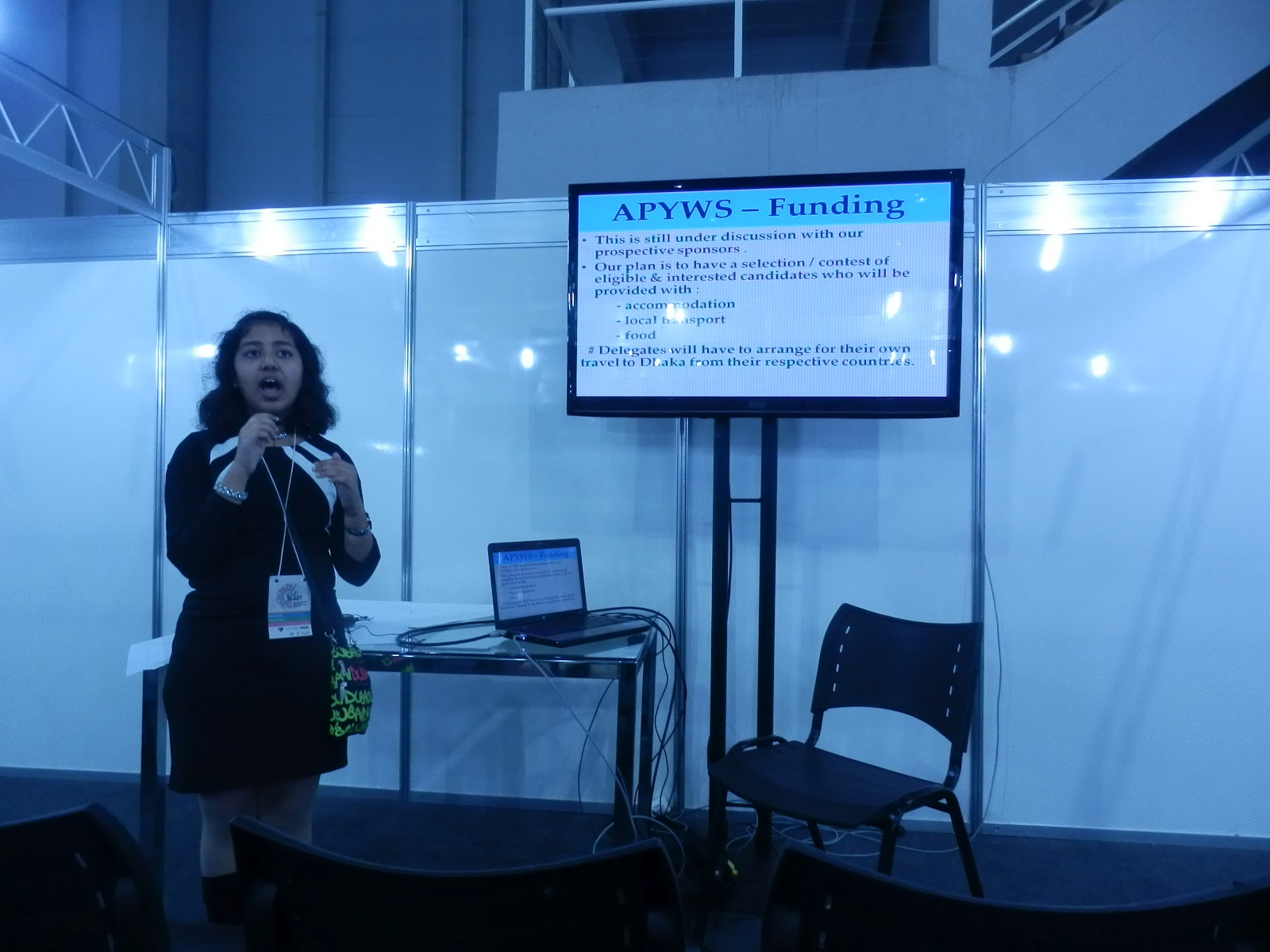
This girl--I forgot her name, is very young (about 13 years old). She conducted a workshop on 'Water'.
A discussion on whether we should create a environmental organisation after UNEP, to create a operative council executive OR create one underneath UNEP?
Four of the Eight Proposals of MGCY in Rio+20: Calling for ombudspersons at all levels, Upgrade of UNEP, Creation of Sustainable Development Council, Effective implementation and public participation in environmental decision-making. See full version in Institutional Framework for Sustainable Development (IFSD)
The kids from various countries contributed their drawings to voice out the things they want for the earth.
People from WYC came here to support the 20 solutions!
There were not many participants attended the so called Official MGCY event... the conference hall was suddenly becoming too spacious. While in some rooms, workshops were fully attended, but some were left emptied. People come and go, come and go. The plenary hall was quite emptied all the time when we had a major discussion on the MGCY Objective working group. It was said that Youth Blast failed to ignite youth outside (Read Youth Blast fails to ignite) since there were not many participation of youth. I personally thought there were not many Asian showed up at the conference, not only due to expensive flight expenses, but little knowledge about the Youth Blast event itself among the green circles,, not to mention how the publicity of this event reached to the media itself.
I could say there were very very few people from Far East attended this event. Even there were a few Asian faces appeared, they were students who are studying in U.S, Canada or Europe countries, and representing some organisations from their universities.
A new exposure. I ended my day by painting the banner to be exhibited at Rio+20!
Theme: Keep the oil in the soil, and the coal in the hole!
This painting was made by an artist, this was where I met Kjell Kuhne from
Plant-for-the-Planet
He's been teaching in Kalimantan so I spoke Bahasa Malaysia with him~^^